Bird's Nest Fern Care Guide
Glossy rippled fronds from a central nest, fully pet safe, and happy in the lower light that ferns are famous for wanting. Its one real demand is humidity.
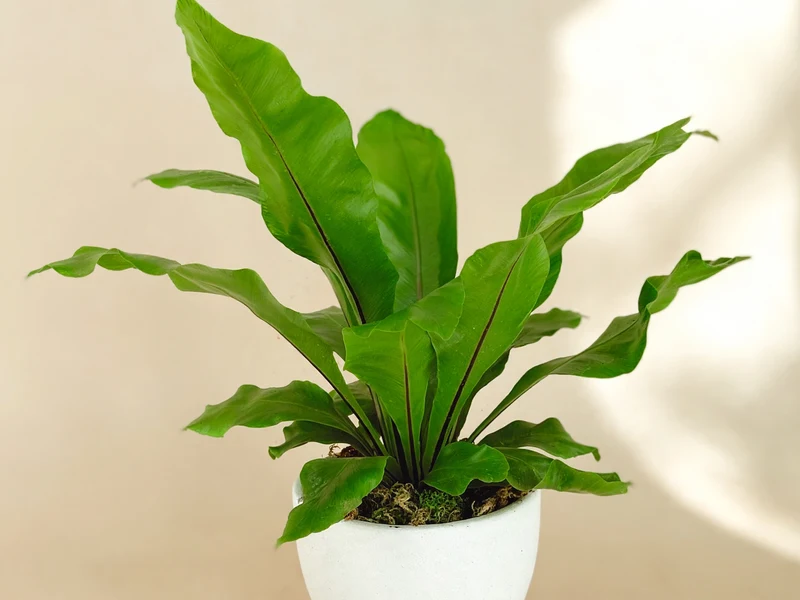
Bird's Nest Fern — Care Dashboard
Light
Medium to low indirect light suits it best. Direct sun scorches the fronds; a north or east window is ideal.
Water
Keep the soil evenly moist and water around the edge of the pot, never into the central nest, which rots if it stays wet. It loves a bathroom with a window.
Soil and potting
It wants a rich mix that holds moisture without turning to mud: regular potting soil with a good handful of compost or leaf mould and some bark stirred through. A plastic or glazed pot holds moisture better than terracotta here. Repot rarely, only when roots have filled the pot completely, and never bury the central nest below soil level.
Humidity and temperature
This is the section that decides whether this fern loves you. It wants 60 to 80 percent humidity, far above what most living rooms offer in winter. A bright bathroom is the classic answer. Grouping it with other plants, standing the pot on a tray of wet pebbles, or running a small humidifier nearby all help. Misting feels helpful but raises humidity for minutes, not days. Keep it between 18 and 24 degrees, away from radiators and cold drafts alike.
Feeding
A gentle feeder. A liquid houseplant feed at quarter strength once a month in spring and summer is enough. Strong feeding scorches the frond edges, and salts build up fast in a plant that stays moist, so err on the weak side and flush the pot with plain water every couple of months.
Propagation
Honest answer: leave this one to the nurseries. Bird’s nest ferns grow from spores dusted on the undersides of mature fronds, and raising them at home takes months of sealed, sterile, steamy conditions for a very uncertain result. The crown cannot be divided. Enjoy the one you have, and buy its friends.
Common problems
| Symptom | Likely cause | Fix | |
|---|---|---|---|
| Brown edges creeping along the fronds | Air too dry | Raise the humidity around it with a pebble tray, a humidifier, or a bathroom spot | Humidity |
| Centre of the rosette turning brown | Water sitting in the nest | Water around the rim of the pot only, and tip out anything that collects in the crown | Water |
| Fronds pale and washed out | Too much direct light | Move it back from the window; it colours best in soft indirect light | Light |
| Brown bumps along the fronds | Scale insects | Pick them off with a fingernail or a cotton bud dipped in rubbing alcohol, and recheck weekly | Pests |
Quick questions
Is a bird's nest fern safe for cats?
Yes. The ASPCA lists it as non toxic to cats and dogs, which makes it one of the best ferns for pet homes.
Why do the frond tips keep going brown?
Dry air is the cause in most homes, especially with heating running. Steady humidity fixes it; misting alone only helps for an hour or so.
Can I split it to make more plants?
Not really. It grows from a single crown, and splitting that crown kills the plant. Ferns like this are raised from spores, which is slow work best left to nurseries.
Sources: ASPCA Toxic and Non Toxic Plants list; NC State Extension Plant Toolbox; Missouri Botanical Garden Plant Finder · Care facts last verified October 2026.