Golden Pothos Care Guide
The plant that survives everything short of total neglect. Trails beautifully, roots in a glass of water, and tells you plainly when it is thirsty.
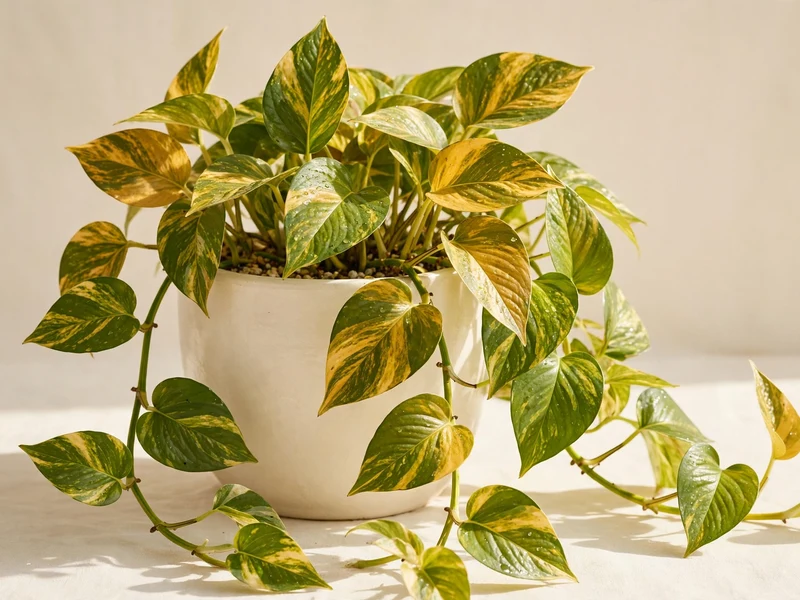
Golden Pothos — Care Dashboard
Light
Almost anything except harsh direct sun. Variegation fades in very low light; bright indirect light keeps the gold markings strong.
Water
Soak it when the soil is dry most of the way down and the leaves just begin to soften. It forgives the odd missed week.
Soil and potting
Any standard indoor potting mix suits it, with a handful of perlite stirred through so water moves freely. The pot needs drainage holes; this plant forgives a missed watering far more easily than a soggy one. Repot when roots start circling out of the drainage holes, going up one size, roughly five centimetres wider. It is quite happy slightly snug, so there is no rush.
Humidity and temperature
Average rooms suit it fine, anywhere in the 40 to 60 percent range it already lives in. It grows faster and pushes bigger leaves with higher humidity, which is why it loves a bright bathroom. Keep it between 18 and 27 degrees and away from cold windows in winter; chilly drafts are a common cause of sudden yellow leaves.
Feeding
A balanced liquid houseplant feed at half strength every four to six weeks through spring and summer keeps growth strong. Pale, slow growth in the growing season is usually hunger rather than light. Stop feeding in winter, and run plain water through the pot every couple of months to wash out built up salts.
Propagation
The easiest plant in the world to multiply. Snip a stem just below a node, the knobbly joint where a leaf meets the stem, and stand the cutting in a glass of water on a bright sill. Roots show within a couple of weeks. Pot it up when the roots reach about five centimetres, or leave it in water indefinitely.
Common problems
| Symptom | Likely cause | Fix | |
|---|---|---|---|
| Yellow leaves | Too much water, too often | Let the soil dry most of the way down before watering again, and always empty the saucer | Water |
| Gold markings fading | Not enough light | Move it to brighter indirect light; new leaves will come through with stronger colour | Light |
| Brown crispy leaf edges | Dry air or very uneven watering | Water on a steadier rhythm and keep it away from heating vents | Humidity |
| White cottony clusters in the leaf joints | Mealybugs | Wipe them off with a cotton bud dipped in rubbing alcohol, and repeat weekly until they are gone | Pests |
Quick questions
Is golden pothos safe for dogs?
No. It contains calcium oxalates and the ASPCA lists it as toxic to cats and dogs. Hang it or shelve it well out of reach.
Can a pothos live in water for good?
Yes, many do for years. Change the water every week or two and add a drop of liquid feed now and then, since plain water carries no food.
How do I make mine fuller instead of one long vine?
Prune the longest stems back to a node and root the cuttings in the same pot. The mother stem branches, and the cuttings fill the gaps.
Sources: ASPCA Toxic and Non Toxic Plants list; NC State Extension Plant Toolbox; Missouri Botanical Garden Plant Finder · Care facts last verified October 2026.