Jade Plant Care Guide
A slow growing succulent tree that can outlive its owner. Paddle leaves store water, so its whole care plan is sunshine and restraint.
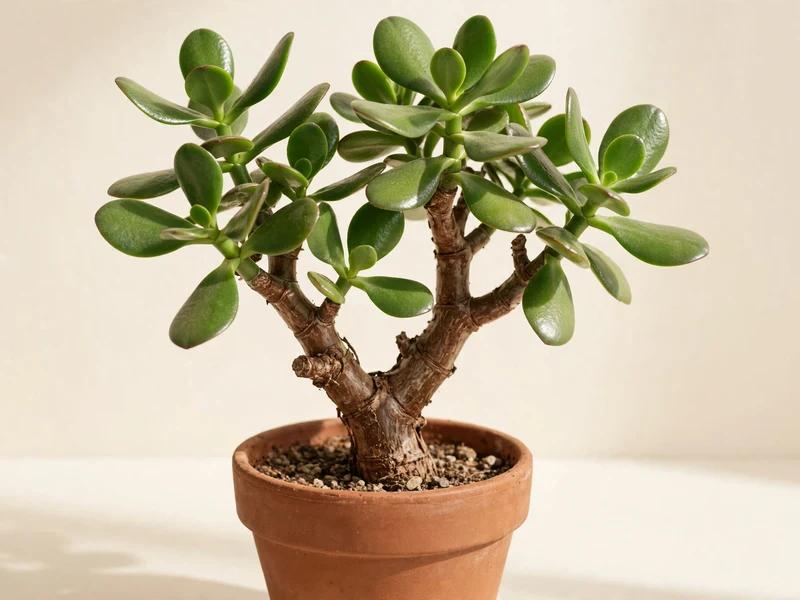
Jade Plant — Care Dashboard
Light
Give it your sunniest sill. Leggy, stretched growth is a jade asking for more light.
Water
Soak, drain, and then wait until the soil is fully dry and the leaves feel just slightly less plump.
Soil and potting
Think mineral, not soil. A cactus and succulent mix, or half potting soil and half perlite, pumice, or coarse grit, keeps water moving past the roots instead of pooling. A terracotta pot suits it twice over: it breathes, and its weight anchors a plant that grows top heavy with age. Always drainage holes, always a pot only slightly wider than the root ball.
Humidity and temperature
Dry air is home. The 30 to 50 percent humidity of an ordinary room needs no help from trays or misters, and wet leaves invite rot rather than gratitude. Keep it between 18 and 24 degrees in the day, and do not let it freeze: frost turns the water filled leaves to mush overnight. Bring outdoor plants in well before the first frost.
Feeding
Very little, very rarely. A cactus and succulent feed at half strength two or three times across spring and summer covers the year. Rich soil and frequent feeding make soft, stretched growth that snaps and rots easily; a slightly hungry jade stays compact and sturdy.
Propagation
Leaves and stems root with almost insulting ease. Snap off a healthy leaf or a short stem cutting, let the cut end dry and seal for three or four days, then lay it on dry gritty mix. Roots form within a few weeks with barely a sprinkle of water. Many a windowsill jade began as a single fallen leaf someone refused to throw away.
Common problems
| Symptom | Likely cause | Fix | |
|---|---|---|---|
| Leaves and stem going soft and mushy | Overwatering rotting the roots | Stop watering, remove every soft part, and repot what is firm into dry gritty mix | Root Rot |
| Leaves wrinkling and shrivelling | Badly thirsty | Water deeply once and let it drain; the leaves plump back up over the next few days | Water |
| Stems stretching with wide gaps | Not enough light | Move it to your sunniest sill gradually, and prune the stretched tips to encourage branching | Light |
| White cottony fluff in the leaf joints | Mealybugs, a jade plant classic | Dab each one with a cotton bud dipped in rubbing alcohol; never spray this plant with soapy water mixes | Pests |
Quick questions
Is a jade plant safe for dogs?
No. The ASPCA lists it as toxic to cats and dogs if ingested. Its branches are also tempting chew targets, so keep it on a high sunny sill.
Why are the edges of the leaves turning red?
That is a sun blush, and it is healthy. Bright light colours the leaf edges red, especially in cool weather. It means the plant is getting the light it wants.
How long can a jade plant live?
Decades, genuinely. Slow steady growth, a mineral rich mix, and rare watering will carry one through generation after generation; many are handed down as family plants.
Sources: ASPCA Toxic and Non Toxic Plants list; NC State Extension Plant Toolbox; Missouri Botanical Garden Plant Finder · Care facts last verified October 2026.